
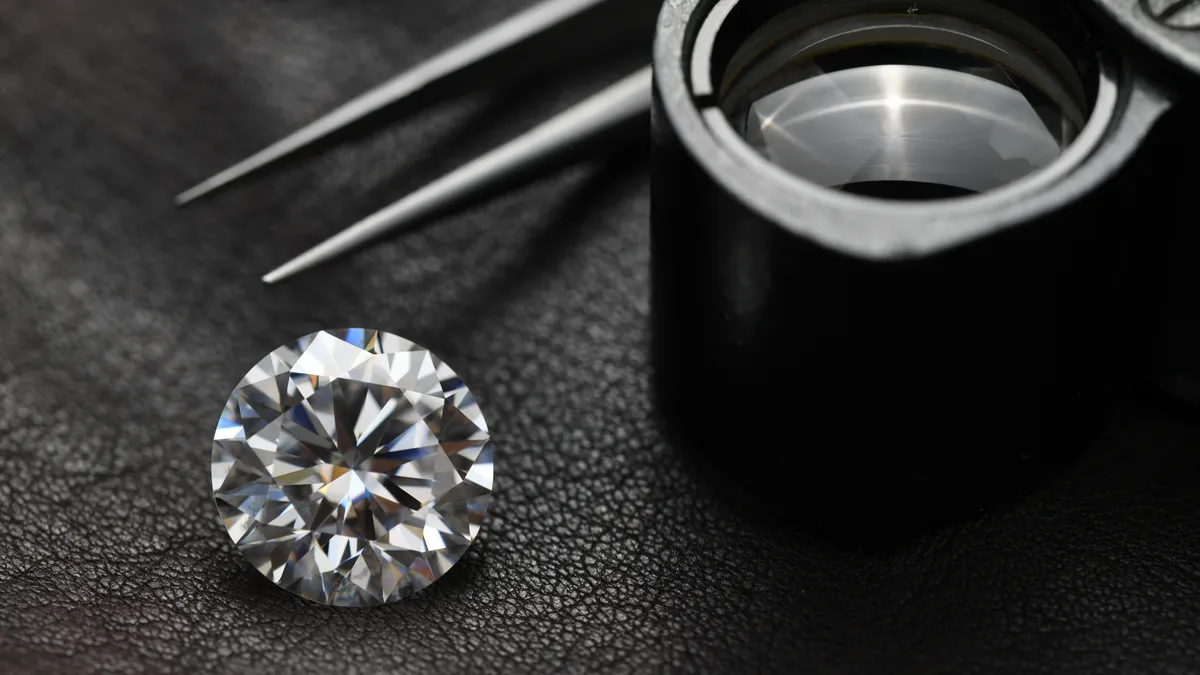
Choosing a diamond means judging a tiny stone on traits you may have first heard about last week. The shoppers who feel best about their purchase learned a few things in the right order.
Before buying a diamond in Cleveland or anywhere else, learn what the 4Cs describe, ask for an independent grading report, and see the stone in person next to others. Set your budget around your priorities, and buy from a jeweler who takes the time to explain the stone.
What the 4Cs Describe
Color, clarity, cut and carat weight together describe the quality of a finished diamond. If you want the full scales, the 4Cs are laid out on our education page, and the short version follows.
Color runs from colorless to light yellow, and the colorless end is the rarest. Clarity covers the tiny natural marks inside a stone, graded across 11 steps from Flawless to Included. Cut is how well the stone handles light, which you see as brightness, flashes of color and patches of light and dark. Carat weight is measured in metric carats, with 100 points to each one.
Why the Lab Report Matters
A grading report is an unbiased assessment of a diamond's quality, written by an independent lab with no stake in the sale. It also discloses any treatments used to change a stone's color or clarity, which is hard to judge by eye.
GIA, the lab that developed the 4Cs grading system, lets you enter a report number online to check the details. A laser inscription on the girdle can carry that number, so the stone can be matched to its paperwork. If you're buying loose, ask to see the report before the stone goes into a mounting.
Choosing a Shape and Setting
Two diamonds of the same weight can look quite different once shape enters the picture. Shape changes how a stone looks on the hand, so try a few. Your partner's everyday style beats any chart!
The setting is the frame, and it changes how the stone sits, how much light reaches it and how the ring wears day to day. Many people pick the diamond first, then decide on a mounting that shows it well. If nothing off the shelf feels right, custom design is another way to get there.
Setting a Budget Around Your Priorities
Start with what the ring needs to do: how long it will be worn, and how hard. Which of the 4Cs would your partner notice first? A setting in platinum, a halo of smaller stones or a custom band all pull the total in different directions, and so do extras like insurance and resizing.
Share a comfortable range with your jeweler and let them show you what fits. If spreading the cost helps, our financing options include monthly payments through Affirm.
Natural or Lab-Grown
Natural and lab-grown stones are both real diamonds, and how they came to be is the main difference. The choice often comes down to what matters most to the two of you, and our post on natural vs. lab-grown diamonds walks through the decision in full.
Questions to Ask Before You Buy
Ask these to any seller, ours included!
Does the stone come with a grading report, and from which lab?
Is the report number inscribed on the stone?
Where are the inclusions, and can I see them under magnification?
How does it look beside a second stone with a different cut or color grade?
Is it natural or lab-grown, and does the paperwork say so?
What is the return or exchange policy?
What a Showroom Appointment Adds
Photos and certificates only go so far. A diamond that looks perfect on a screen can look totally different on the hand, and the only way to know is to see it in person. Ask to look at stones loose, under magnification, and side by side.
From our Avon Lake showroom we serve shoppers across the Cleveland area, and our team includes a GIA Graduate Gemologist and an AGS Certified Gemologist Appraiser. You can browse our diamonds before you visit, and once you've bought, our gemologists offer jewelry appraisals. We're a family-run store, and we want you to leave informed, with a stone you understand and a ring you'll be glad to wear for decades.
Diamond Buying Questions
Do I need a lab report for a diamond?
Yes, a grading report is worth having for any diamond you're paying real money for. It's an independent assessment of the stone's quality, and it discloses treatments used to change color or clarity. It gives you something concrete to check the stone against and a fair way to compare two diamonds.
What is the difference between a grading report and an appraisal?
A grading report is an independent assessment of a diamond's quality, while an appraisal gives it a monetary value. One describes the stone and the other puts a number on it. Our gemologists handle jewelry appraisals once the diamond is part of your finished ring.
Which of the 4Cs matters most?
All four matter, and your priorities decide the balance. Cut is a good place to start, since it shapes how much a diamond sparkles. From there, think about what your partner would notice first, and let that guide where you give a little.
Should I choose the diamond or the setting first?
Choose the diamond first, then the setting. A loose stone lets you judge it on its own merits, and you can pick a mounting that suits its shape and size. If you've already fallen for a finished ring, that's fine too. Just ask about the stone's details before you decide.
Can I see diamonds in person before I decide?
Yes, and we'd encourage it. Seeing stones in person, loose and under magnification, is the best way to tell how a diamond really looks. We're happy to help you compare options at your own pace, and you can reach out to plan your visit.
Talk With a Diamond Expert
If you're weighing stones and want a second opinion, we'd love to help. Talk with a diamond expert at Peter & Co. Jewelers, and we'll go through the 4Cs, the paperwork and the setting at a pace that suits you.