
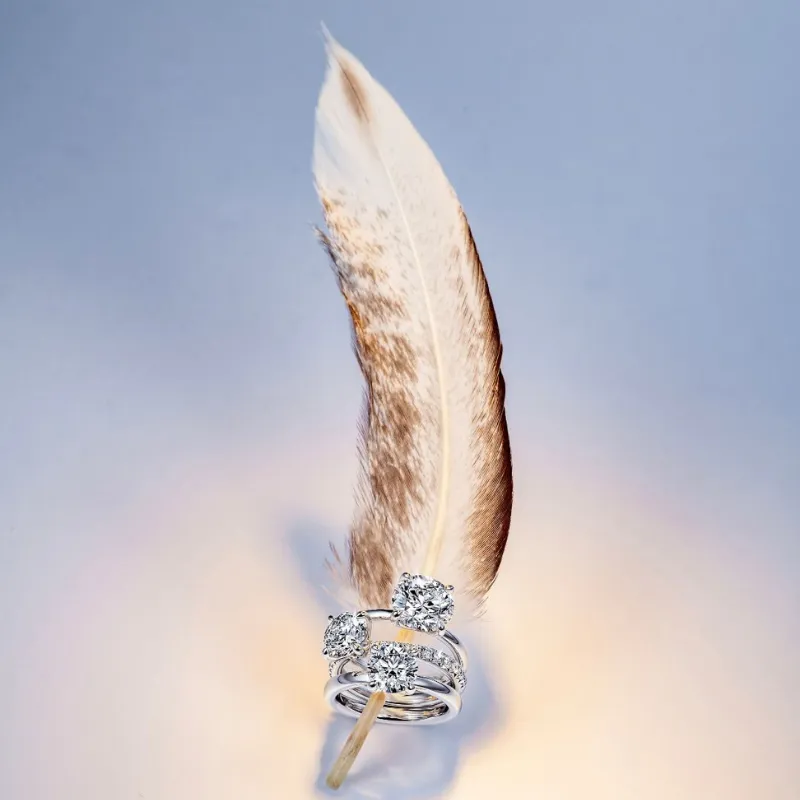
At Peter & Co. Jewelers in Avon Lake, Ohio, we offer a wide range of designer engagement rings. And with so many choices in our store and online, we understand that finding the perfect piece may take a little extra time. Here, we offer a step-by-step guide for selecting an engagement ring that's just as special and unique as its wearer.
Step 1: Choosing a Ring Material
The first step in finding an engagement ring is deciding which type of metal you want. Peter & Co. Jewelers offers four options for engagement ring bands:- White gold: An alloy of pure gold and a metal like manganese, nickel, or palladium, white gold is a popular contemporary style that looks like platinum but is less costly.
- Yellow gold: An alloy of pure gold combined with zinc or copper, yellow gold has a classic, timeless look.
- Rose gold: A gold-copper alloy that has a pinkish tint, rose gold is rising in popularity.
- Platinum: The heaviest and rarest of all precious metals, platinum is hypoallergenic and also resistant to corrosion.
Step 2: Choosing a Ring Setting
Once you’ve identified the metal that best fits your aesthetic and needs, you can set a price range for your ring. Then, you’ll choose a setting, which dictates the style of the band and the number of stones. Settings include the following:- Bypass: A bypass setting has a fluid look in which the band appears to curve around a center stone with a twisted or braided appearance.
- Halo: A halo setting features a center diamond surrounded by a ring of smaller stones that lends extra sparkle and makes the center stone appear larger.
- Multi-row: Also referred to as a "split shank," this setting's band is forked on either side of the center diamond.
- Pave: A pave setting has tiny gemstones set into the band in addition to a center diamond.
- Side-stone: This setting highlights a center diamond with two smaller side stones in a different cut, such as baguette or square.
- Single row: With this setting, a center stone is enhanced by a row of tiny stones placed in a groove in the band.
- Solitaire: A popular engagement ring style, this setting has a simple, minimalist band to highlight a single center diamond.
- Three-stone: This setting showcases a trio of stones, with a center diamond and two side stones that may be similar-sized diamonds or other gemstones.
Step 3: Choosing a Diamond
Next, browse a comprehensive selection of diamonds and gemstones in our store and online to compare quality and price. Guiding your choices with the classic "Four Cs" of diamond quality can help you find the perfect stones for your engagement ring. The Four Cs are defined as follows:- Carat: This is the measurement of a diamond’s weight and size.
- Color: The most popular diamonds are colorless to near colorless, but they come in a wide spectrum of shades.
- Cut: This refers to the symmetry and proportions of a diamond and how well it is cut.
- Clarity: This measures the amount of a diamond’s internal markings or characteristics within the diamond known as inclusions.
- Asscher
- Cushion
- Emerald
- Heart
- Marquise
- Oval
- Pear
- Princess
- Round
- Radiant